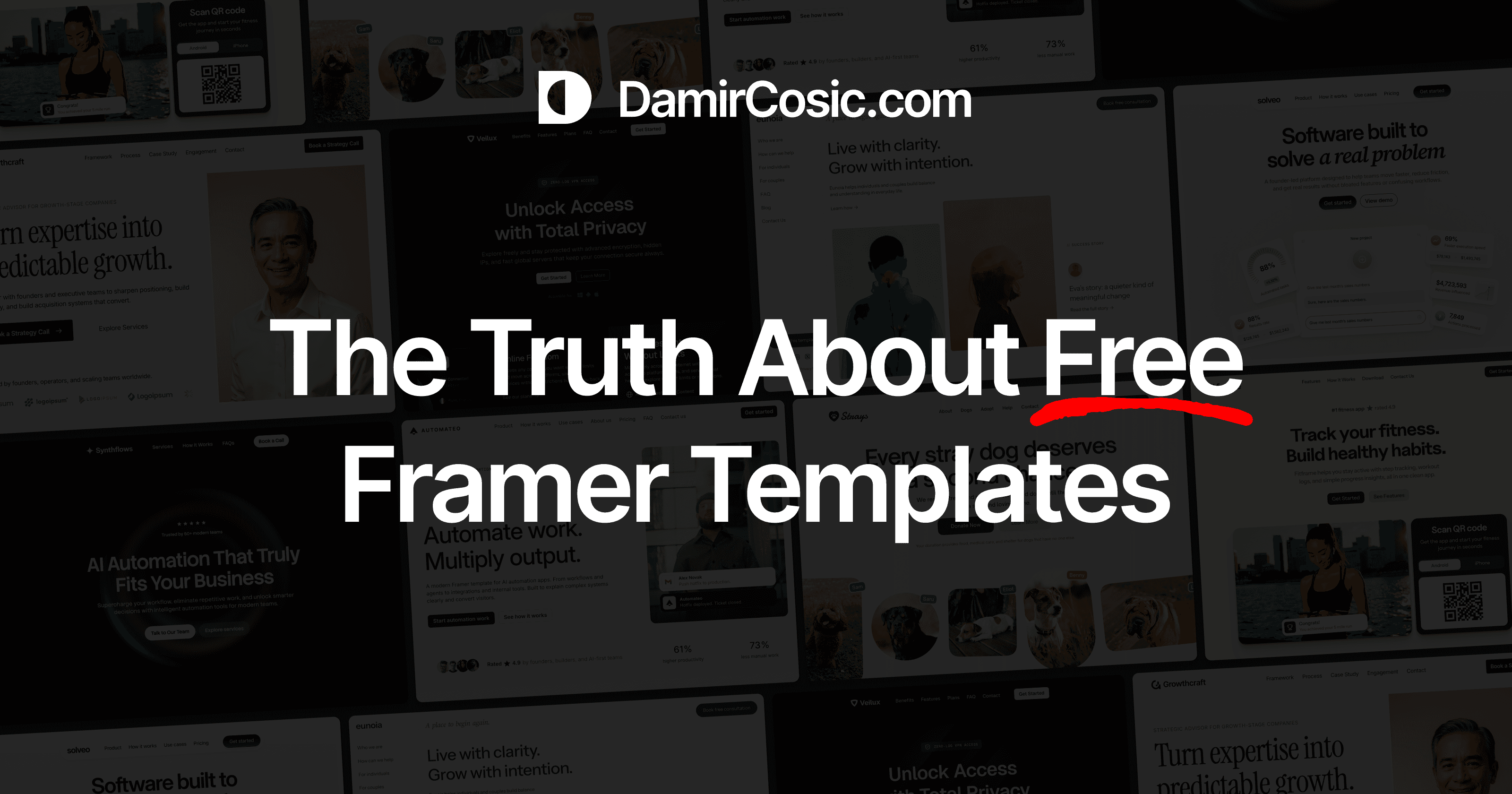
Free does not mean low quality. This is a look at why purpose-built free Framer templates are genuinely good enough for real projects, with 10 templates as proof.
Short answer: yes. But let me show you exactly why, with 10 templates as proof.
There is a common assumption in the design world that free means compromised. That somewhere in the process of making something free, corners were cut, features were removed, or quality was traded for volume.
That assumption is wrong, at least when it comes to Framer templates.
I have built 10 free Framer templates over the past year, used by more than 600 founders worldwide. In that time I have learned a lot about what makes a free template actually worth using and what separates a good one from a throwaway file. This article is my honest take on the question, with real examples from my own collection.
What Makes a Framer Template "Good Enough"?
Before answering whether free templates are good enough, it helps to define what good enough actually means for a real project.
A template is worth using if it meets these criteria:
It is built for a specific use case, not a generic layout
It is fully customizable without touching code
It has a clear conversion structure, not just aesthetic design
It can be published and look professional without major rework
It saves meaningful time compared to building from scratch
With that definition in place, let's get into the real answer.
Why Free Framer Templates Are Actually Good
1. The best ones are purpose-built, not generic
The biggest problem with low-quality templates is not that they are free. It is that they were designed to look impressive in a screenshot rather than to work for a specific audience.
A good free Framer template starts with a use case, not an aesthetic. That means the layout, the copy structure, the CTA placement, and the page flow are all designed around how a specific type of visitor behaves and what they need to see before they take action.
Take Veilux for example. It is built specifically for SaaS products in the privacy and security space. The messaging hierarchy is designed around trust, the visual language is dark and credible, and the CTA structure reflects how security buyers evaluate software. A generic SaaS template would not have made those choices intentionally. Veilux did.
The same is true for Strays, built for charities and nonprofits. The emotional storytelling flow, the donation-focused calls to action, and the mission-first layout exist because the template was designed for that context specifically, not adapted from a SaaS layout with different colors.
The lesson: when a free template is built for your use case, it competes directly with paid options. The "free" part is about the price, not the thinking behind it.
2. Framer makes quality templates genuinely easy to customize
A template is only as good as how easy it is to make your own. In older web builders, even decent templates required wrestling with hidden settings, locked layers, or code dependencies that made real customization a headache.
Framer changes that. Every template built natively in Framer is editable through a clean visual interface. You can update colors, fonts, copy, images, layout, and animations without writing a single line of code. The design system is accessible, not buried.
This matters for free templates specifically because it removes the main objection. The old worry was: even if the template is free, making it look like mine will cost time or money. In Framer, that is no longer true. You can take a template like Growthcraft, built for consultants and advisors, and have it branded to your business in under an hour.
What you can change without code:
Brand colors and typography across the entire site
All copy, headings, and body text
Images and visual content
Section order and page structure
CMS content (blog posts, case studies, team members)
Navigation and footer links
3. Free templates can have the same structural depth as paid ones
One of the legitimate concerns about free templates is that they are stripped-down versions of something more complete. A homepage and nothing else. No CMS. No inner pages. No thought given to the actual user journey.
The best free Framer templates are not like that.
Solra, for example, is a free template for AI SaaS founders that includes a full page set, CMS collections, and a built-in waitlist flow. That is not a trimmed-down product. That is a complete website ready to support a real product launch.
Clarion, built for AI consulting and strategy websites, includes solutions pages and a full blog, not just a landing page. Automateo, one of the most popular templates in the collection, is structured specifically to explain complex workflows and convert users, which requires real UX thinking, not just visual layout.
The structural depth in these templates exists because they were designed to be used, not just downloaded.
4. Niche templates outperform generic ones, at any price
There is a counterintuitive principle at work in template design: the more specific the template, the more useful it is, even if that narrows the audience.
A general-purpose "startup" template forces you to strip out everything that does not apply to you and rebuild the parts that are missing. A niche template built for your exact use case gives you a running start.
Here is a look at the full collection and what each one is built for:
Template | Best For |
|---|---|
AI SaaS founders who need a full launch-ready site with waitlist | |
AI consulting and strategy businesses | |
SaaS and automation tools with complex workflows to explain | |
AI products showcasing how their system works | |
SaaS products in privacy, security, and trust-driven categories | |
SaaS products needing a structured solution-focused landing page | |
Consultants and advisors positioning their expertise | |
Therapists, coaches, and wellness professionals | |
Fitness apps and coaches converting visitors into members | |
Charities, nonprofits, and animal shelters |
When you find the template that matches your use case, you are not starting from scratch. You are starting from a foundation designed with your audience already in mind.
5. The time savings are real and significant
Custom Framer websites take time to build well. Depending on complexity, a full site build can take anywhere from several days to several weeks, and that is before accounting for revision cycles.
A good template collapses that timeline dramatically.
With a purpose-built template, the structural decisions are already made. The sections are in the right order. The conversion logic is in place. The CMS is configured. The mobile layout is handled. What is left is customization, which is a much faster and lower-stakes task than building from zero.
For founders, consultants, and small teams who need a professional web presence quickly, this is the actual value proposition of a free Framer template. It is not just that it costs nothing. It is that it costs very little time either.
6. Good free templates are built by designers with real experience
Templates made by designers who understand both visual design and conversion strategy produce better results than templates made by someone optimizing for visual appeal alone.
This is where the background behind the template matters. The collection at damircosic.com/templates comes from 10+ years of UI/UX and product design experience across SaaS, AI products, fintech, and cybersecurity. The design choices in each template are not arbitrary. They reflect real decisions about layout, hierarchy, and user flow made in the context of actual product work.
That experience does not cost extra when the template is free. You get the same design thinking either way.
The One Honest Limitation
Free templates are not right for every situation.
If you have highly specific brand requirements, a complex product with multiple user types, or a need for deep custom functionality, a template of any kind is going to have limits. At that point, a custom build makes more sense and is worth the investment.
But for most founders, early-stage SaaS products, consultants, coaches, nonprofits, and wellness professionals who need a professional website quickly and without a large budget? A purpose-built free Framer template is genuinely good enough. In many cases, it is the smart choice.
Frequently Asked Questions
Are free Framer templates actually free to use? Yes. Every template in this collection is free to use with no payment or account required. You open the remix link, customize inside Framer, and publish.
Can I customize a free Framer template to match my brand? Yes. All templates are fully editable inside Framer. You can change colors, fonts, copy, images, and layout without any coding.
Are free Framer templates good for SEO? Framer has strong built-in SEO capabilities including clean markup, fast load times, and proper meta tag support. A well-structured template gives you a solid SEO foundation from day one.
Which free Framer template is best for SaaS? Veilux and Solveo are built specifically for SaaS products. For AI tools and automation, Automateo and Synthflows are stronger choices.
Which free Framer template is best for consultants? Growthcraft is designed specifically for consultants and advisors who want to showcase expertise and win clients.
Which free Framer template is best for nonprofits? Strays is built for charities, nonprofits, and animal shelters, with a mission-first layout and donation-focused calls to action.
Do free Framer templates include a blog or CMS? Some do. Solra and Clarion both include CMS collections and blog functionality out of the box.
How long does it take to customize a Framer template? For most use cases, a basic brand customization takes under an hour. A fully customized, publish-ready site typically takes one to two days of focused work.
The Bottom Line
Free Framer templates are good enough for real projects when they are built with purpose, designed for a specific use case, and backed by real design experience.
The 10 templates in this collection cover AI SaaS, automation tools, security products, consulting businesses, wellness professionals, fitness coaches, charities, and more. Each one is free, fully customizable, and built to be used, not just previewed.
If you are trying to decide whether a free template can work for your project, the honest answer is: find the one built for your use case and try it. The barrier to entry is zero.